Why Your Next Industrial SCADA Framework Should Start on a Desk
In modern industrial environments, testing a new SCADA monitoring script or an aggressive failure scenario directly on a live, revenue-generating production asset is out of the question. Interrupting a critical water treatment pump or an automotive assembly line introduces massive financial liabilities and equipment risks.
But what if you could test complex, bidirectional industrial communication loops right on your desk for a fraction of the cost?
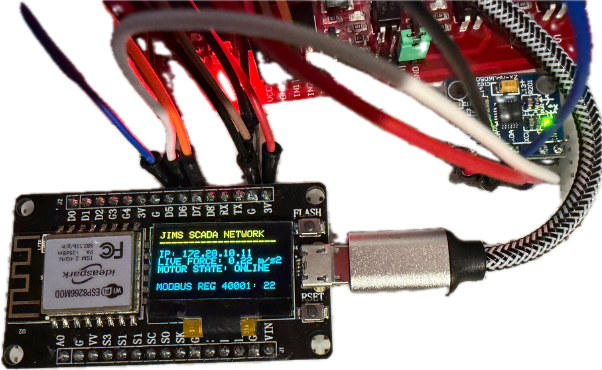
Enter the Desktop Digital Twin. We recently built a physical-to-virtual closed-loop prototype that replicates real-world industrial machinery, proving that high-level edge testing doesn’t require thousands of dollars in commercial PLCs.
The Architecture: True Bidirectional Control
A genuine Digital Twin can’t just be a passive dashboard; it requires a closed-loop ecosystem. Our prototype achieves this via two distinct paths:
- Telemetry (Physical to Virtual): Raw vibration data is collected at the hardware edge by an accelerometer mounted on a high-torque DC motor. This data is processed locally and pushed over Wi-Fi.
- Actuation (Virtual to Physical): If a dangerous anomaly is detected, a hardware interlock instantly triggers at the edge. To resume operations, a secure override signal is sent backward from the virtual dashboard over the airwaves to safely restart the system.
  [ PHYSICAL ASSET ] --------(Live Telemetry)--------> [ VIRTUAL TWIN ]
  (Motor & Sensors)                                    (Node-RED SCADA)
          ^                                                   |
          |-------------(Remote Safety Reset)-----------------|
The Tech Stack
Instead of proprietary, locked-down industrial hardware, we built this sandbox using highly accessible, open-standard technologies:
- The Brain & Sensor: An ESP8266-based microcontroller paired with a multi-axis accelerometer.
- The Language: The system communicates using Modbus TCP—the open, foundational language of global industrial automation.
- The Virtual Twin: A custom Node-RED SCADA dashboard that provides real-time gauge feeds, historical charts, and remote control capabilities.
Edge-Level Safety in Action
To ensure zero lag, the critical safety cutoff logic happens entirely at the hardware level. If the sensor detects a vibration spike that crosses our threshold, a local relay instantly breaks the power loop and stops the high-torque motor dead in its tracks—completely independent of network latency. The virtual twin is notified instantly, locking the system until an operator manually clicks “RESET SAFETY SYSTEM” on the SCADA dashboard.
What’s Next: Scaling Outward
Now that the desktop sandbox has successfully verified our core bidirectional framework, we are scaling this architecture into enterprise-grade deployments:
- Phase 2: Cloud Analytics (AWS): Moving from local dashboards to the cloud. We will be streaming the Modbus telemetry into AWS IoT Core and Amazon Timestream, leveraging SageMaker machine learning to predict mechanical failures before they cross a critical threshold.
- Phase 3: Deep Scaled Autonomy: We are expanding this exact edge-control framework to convert a 1/14th scale conventional haul truck model into a fully autonomous mobile asset featuring LiDAR spatial tracking and remote fleet management.